
Political Will Is Not Enough. Build the Capability.


Every African government I have worked with has had political will. This may sound surprising given how often reforms stall, projects underperform, and citizens lose confidence in public institutions. I have sat across the table from presidents, ministers, senior civil servants, and their technical teams, and I have rarely met a leader who did not want to deliver. The problem is rarely the absence of commitment. The problem is that political will is often mistaken for a delivery system. It is not.
I call this the delivery gap: the distance between political commitment and citizens’ experiences. Citizens do not experience speeches, frameworks, or manifesto commitments. They experience whether public services work when they need them. When these outcomes fail to materialise, the gap is rarely a gap of intention. It is a gap of architecture.
Governments do not fail because they lack plans. Africa may be the most over-planned continent in the world. National development plans, sector strategies, reform roadmaps, vision documents, most countries have all of them, and most are technically sound. Yet citizens do not experience plans. They experience services. Between the plan and the service lies a space where many reforms quietly die, not from sabotage, but from drift: goals too broad to own, accountability spread too thinly, and review cycles too slow to catch problems before they become crises.
Three myths keep this gap alive. The first is that political will means leaders care. Most do. The second is that political will guarantees implementation. It does not, because commitment is not a system. The third is that more political will solves delivery problems. It rarely does, because the constraint is seldom enthusiasm.

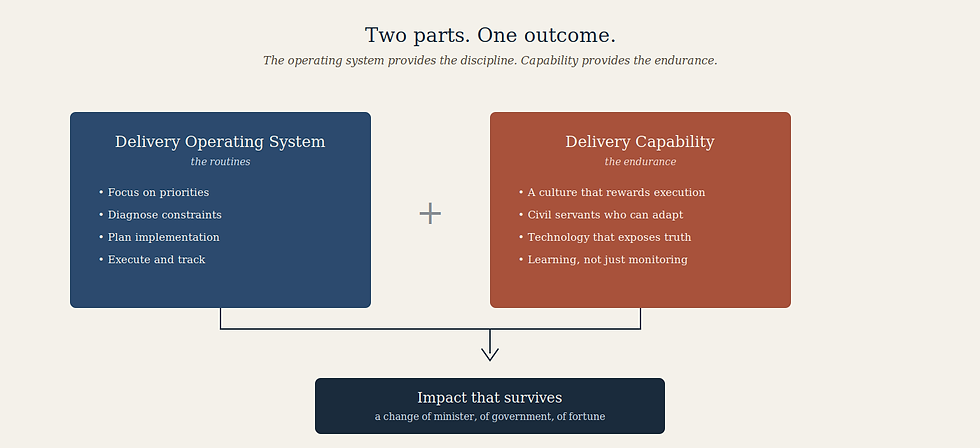
So what does a government actually need? It needs two things: a Delivery Operating System and the capability to sustain it.
The Delivery Operating System is the repeatable set of routines through which governments translate political commitment into measurable results. It starts with ruthless prioritisation, choosing the handful of outcomes that matter most. It organises government around those outcomes. It diagnoses the real constraints before acting, because activity without an honest diagnosis is just motion. Diagnosis informs financing, staffing, incentives, data needs, procurement, and risk mitigation. From there, priorities are translated into practical implementation plans with milestones and named owners. Every priority needs one accountable team, from senior leadership to the last-mile service provider, who knows their name is attached to the result. Spread a target across a committee, and you have not shared responsibility. You have diluted it.
What follows is execution. Routines that keep reforms moving and remove obstacles as they appear. That discipline depends on data. Not the kind that arrives once a year in a report nobody reads, but on live, operational information that can answer four questions on demand: are we on track, where are we falling behind, why, and what needs fixing now to get us on track.
That data only matters if it lands in a room that takes it seriously: structured performance reviews, held often enough to matter and where leaders ask what changed, why, who is removing the bottleneck, and by when. I have watched that shift happen in different rooms. It is not dramatic. It is the entire difference between a government that talks about delivery and one that does it.
The final element is adaptive problem solving and learning. Most governments monitor. Far fewer learn. The purpose of data is not reporting. It is identifying problems while they are still small enough to fix, understanding why they occur, and adapting before today’s obstacle becomes tomorrow’s institutional failure.
Even the best-designed operating system will fail if governments do not invest in the capability to sustain it: a culture in which leaders reward execution as much as announcement, institutions and civil servants equipped to manage increasingly complex reforms, and technology that makes performance visible and accountability harder to avoid. These allow delivery to survive a change of minister, a change of government, a change of fiscal fortune.
The lack of this architecture explains why so many good policies underdeliver. Human capital and women’s economic empowerment, for example, are rarely short of strategies. Governments frequently cannot answer simple questions. Are children learning? Which districts are falling behind? How many women sustained businesses beyond programme support? Which interventions produced lasting income gains? Without shared priorities, named owners, and timely data, ministries can each report progress while citizens experience none of it.
None of this is purely technical, and it would be dishonest to pretend otherwise. Some reforms fail not because governments do not know what to do, but because incentives are misaligned. Delivery often requires institutions to change behaviours, surrender discretion, share information they would rather control, and accept scrutiny they would rather avoid. These are political challenges, not technical ones. The political cost of admitting a missed target is immediate, but the benefits of genuine reform are long-term. No dashboard fixes that asymmetry on its own. Only leadership willing to absorb short-term discomfort for long-term credibility does.
The real question is what kind of states we should build. Individual reforms come and go with election cycles and ministerial reshuffles. Delivery capability does not. Governments that build and sustain delivery operating systems will continue delivering long after the leaders who initiated those reforms have left office. Those who rely solely on the commitment of exceptional individuals will see progress fade with every political transition.
Citizens do not live inside policy documents. They live inside the consequences of whether those documents are implemented. Political will starts the reform. A Delivery Operating System turns that will into action. Delivery capability ensures that action endures.



Students studying Spanish online often switch between English and Spanish while completing their coursework. This can make accented characters difficult to type when a Spanish keyboard is not available. Keeping a Spanish typing resource available can make digital language practice faster and more convenient.
The article on political will not being enough—building capability is key—offers a practical call to action for leaders. I appreciate the emphasis on execution and capacity building. A public policy management course & workshop for managers in Tunis, Tunisia could help policymakers develop the skills needed to design effective policies, implement them efficiently, and achieve measurable results.
This is a powerful and timely post—political will is important, but building capability is what drives real, lasting change. For policymakers and executives in Algiers looking to strengthen their ability to design and implement effective public policies, I highly recommend the outstanding public policy management seminar & course for executives in Algiers, Algeria—a valuable opportunity to gain the analytical and strategic skills needed for turning vision into measurable impact.
“The political cost of admitting a missed target is immediate, but the benefits of genuine reform are long-term.”
That line explains a lot. Most leaders avoid owning failure because election cycles don’t reward it. In a typical 5-year term, year 1 is setup, years 2-3 are the real delivery window, and years 4-5 are already campaign mode. There’s barely time to see complex reforms through, let alone admit when something isn’t working.
The other point about “delivery architecture” is just as important. In SL, a change in government often means a total reset: new goals, new priorities, new systems, new delivery teams. Until we build delivery systems that outlast political cycles, good policies will keep underdelivering. Most governments also don’…